
Craig LeHoullier is the gardener who gave the beloved Cherokee Purple tomato its name and the author of “Epic Tomatoes” and “Growing Vegetables in Straw Bales.” He’s also my fellow instructor in the Online Gardening Academy™ Growing Epic Tomatoes course and a great friend. He joins me this week for a catch-up on his latest gardening and seed breeding projects.
If you’ve been listening to this podcast for even a little while, there’s a good chance you already know of Craig, and if Craig is new to you, get ready to become a fan. Craig is wicked smart, humble, and generous with his knowledge and love of tomatoes. He’s also very wise. I love having conversations with Craig anytime, but especially during these podcast episodes, which are always full of great insights and takeaways.

Craig LeHoullier with his wife, Sue, at Daniel Stowe Conservancy in Belmont, North Carolina.
Courtesy Craig LeHoullier
Craig, who holds a Ph.D. in chemistry, is world-renowned as one of the most respected experts on tomato growing and breeding. He’s also the co-founder of the Dwarf Tomato Project and the tomato adviser to the Seed Savers Exchange. He lives and gardens in North Carolina.
Catching Up With Craig
People love hearing what Craig is up to and what his thoughts are. Aside from hiking and the delight of watching his young grandson, Craig is busy gardening. He says he’s spending less time on details, but his garden is humming along and he’s having a blast.
There’s no right or wrong when it comes to gardening, he says.
“You need sometimes to give yourself that ability to say, ‘Okay, I’m gonna do a rebuild. I’m gonna take a break. I’m gonna grow less.’ Because there always is — as long as we’re walking on the earth — there’s always going to be a next garden to either catch up on or to do something different in. So, I don’t think any of us who are gardeners realized that we were embarking on a lifelong journey that’s going to be constantly evolving and changing.”
Over the years, I’ve let go of perfectionism, like chasing the perfect lawn. I’ve realized that’s a huge waste of time.
This year, I’m undergoing a complete rebuild of my raised bed vegetable garden, so I don’t have a garden to plant into. But I can’t live without tomatoes in my life, so I threw together a “pop-up” raised bed garden with builder block corners and 2x6s double stacked. I’m going to plant leftover tomato and pepper seedlings from my annual seedling sale with my daughter.

My “pop-up” raised bed garden with tomato cages.
Craig has a great love of tomatoes like me, but gardening in a warm area, he has challenges getting tomatoes and lettuces to grow at the same time to enjoy a fully homegrown salad. It’s one of the challenges that makes gardening interesting.
Craig’s focus has shifted away from heirloom tomatoes a bit and toward amateur breeding, including dwarf tomatoes and indeterminate x indeterminate tomatoes. He continues to have an aversion to most commercial hybrid tomatoes. People look at his plant list, and ask, “Where’s the Better Boy? Where’s the Big Boy? Where’s the Celebrity?”
Craig tells them, “Well, that’s at the big box store in downtown Hendersonville. That’s just not my thing. And there’s nothing wrong with them. They’re just not my thing because heirlooms need people to care for them, and that’s what I’m going to continue to do.”
He is currently growing 28 indeterminate tomatoes in-ground and another 18 in grow bags.
“ Out of those 46, I only know what nine of them are going to do in terms of color, shape, size, flavor,” he shares. “So my garden this year is going to be a complete ‘throw everything in the bag, reach in and see what you get.’ It’s almost all research and development.”
He is seeking to refine a few named varieties that aren’t finished in their breeding yet, and he is growing many Captain Lucky x Sun Gold tomatoes to see if he can get any “winners.”
“Sun Gold is most people’s favorite tasting cherry tomato,” he says. “And we don’t know what the parents are. We know it’s parent A and parent B, and they cross them, and you get Sun Gold seeds. And then Captain Lucky is my now favorite large tomato, and it’s interesting because it’s purple and green.
“So I thought, what happens if you cross these, and then what will the offspring look like?”
His cross yielded an orange cherry tomato that tastes really, really good.
He sent out seeds from his hybrids to some people, and they joined him in growing out the second generation.
He grew one that had oval red-yellow, pink cherry-size fruit that was delicious. “ Another was a green-purple cherry. Other people got almost heart shapes and little mini-beefsteaks and different colors. They sent me all of their seed, and I grew plants from their saved seed. So what we’re doing now is just looking at the color and the flavor range and the size range.”
He notes that small fruit size is a very dominant trait.
“ If we find flavors we like in a cherry tomato, we’re going to have to back-cross that with another delicious large tomato to see if we can hack away at that small fruit size,” he explains. “ So I’ve got a lot of people helping me in this. I sent F2 seed out to at least 50 people, so I’m going to get this avalanche of results coming in, in the fall. Where we go with it doesn’t matter. We’re just looking for fun, interesting, delicious tomatoes. I predict a few new name varieties will come out of this.”

Earl, an indeterminate tomato.
Photo Courtesy of Craig LeHoullier
Growing Corn in Straw Bales
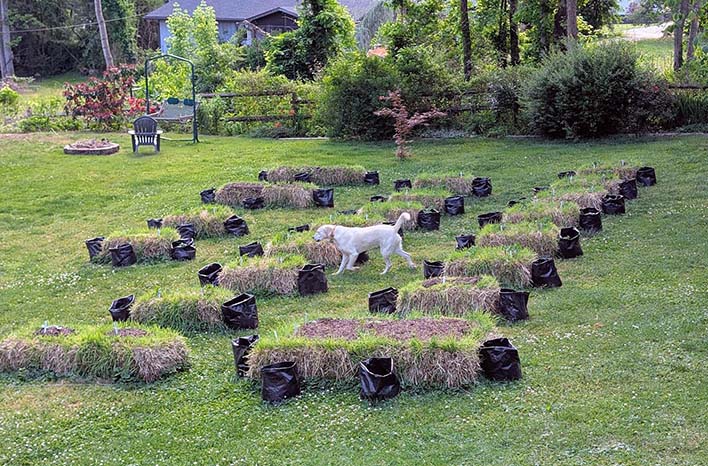
Last year, Craig experimented with growing corn in straw bales.
”The corn, that made my whole season, because I had a theory. ‘I think this will work.’ It worked. It was delicious. And I made a few changes, and I’m doing it again this year.”
Craig successfully grew 50 ears of corn in a 4’x4’ block of straw bales. It goes to show the joy that gardening experimentation can bring.

In addition to being an enthusiastic gardener, Craig LeHoullier is also an avid hiker.
Photo Courtesy of Craig LeHoullier
Dense Seed Starting and Taking Risks
Craig practices dense seed starting. That means instead of putting one or two tomato seeds in each cell of a cell tray, he’ll put dozens of seeds in one cell. He then uses a heat mat, but no grow light, to germinate them. When the seedlings are an inch and a half-tall, he hardens them off outdoors, and after that process, he separates the dense seedlings into their own individual pots.
“ You don’t have to restart the clock again and treat them like they’re newly tender seedlings,” he says of potting up the seedlings. “They retain that hardened off character.”
He did lose a few plants to frost when the temperature dropped to 33°F. Though more than 90% of his plants, all sitting in the same small area, survived. Craig rejects the conventional wisdom that when tomato plants are left out in 40°F lows, they will be stunted. He says that in 20 years growing with the dense planting technique in his driveway, that’s never been a problem.
“ I’ve become more of a risk-taker because I’ve got less time to fiddle around with stuff, and there always is a risk that something will go south on you and you go, ‘Okay. I screwed that up. Now what? Do I start more seeds?’”

A dwarf tomato plant grows in a straw bale.
Photo Courtesy of Craig LeHoullier
Pushing Boundaries with Seeds
Craig loves to push boundaries. For example, he experimented with germinating really old seeds and learned that seeds saved at room temperature can still have a reasonable germination rate after 10 or 12 years.
“ If you’ve got seeds that are really valuable to you, make sure you grow them out sooner,” he says. He did find that old seeds do not have the same vigor and quality of newer seeds.
“You’ll find more what I call ‘mule’ seedlings, where they’ll germinate, but you just get the two cotyledons and nothing comes up beyond it between the two. So you could keep that plant for a month, and all it will be is two fat cotyledons.”
He planted 20 seeds of 2016 Cherokee Purple and Cherokee Chocolate. His germination was about 40% or 50%, and of those, 10% or 20% were just not good seedlings. However, to preserve a seed variety for the future, all you need is one good one.”
He is concerned that as the current seed savers age out, there is no mechanism in place to continue the work.

Here I am with Craig doing a tomato blind taste test.
If you haven’t listened to my catch-up with Craig LeHoullier, you can do so now by scrolling to the top of the page and clicking the Play icon in the green bar under the page title.
How have you experimented in your garden or with seed breeding like Craig LeHoullier? Let us know in the comments below.